This note presents an update of the geographical distribution and spread of Tropilaelaps spp. mites, parasites of bees and exotic in the European Union (EU) as of 24 July 2025. It follows the previous state of play from March 2025. The map of the worldwide geographical distribution of Tropilaelaps spp. was updated accordingly (Figure 1).
The presence of Tropilaelaps spp. is suspected in Belarus and Crimea region (Figures 2 & 3).
Description
Suspected presence in Belarus
During the Belarusian scientific congress of the Vitebsk State Academy of Veterinary Medicine (VSAVM) of 15 and 16 May 2025, a study conducted in the Vitebsk district of Belarus to identify different pests of honey bees was presented. Inspection of 173 bee colonies was performed in apiaries in 2023 and 2024. During apiary inspection, Tropilaelaps spp. specimens were retrieved in 19.54% of cases (Goryachev and Kuzmich, 2025).
Suspected presence in Crimea
In 2023, a study was conducted in the Belogorsk district of Crimea. The objective was to confirm introduction of Varroa destructor and Tropilaelaps spp. in Crimea. One apiary was selected and 249 larvae were sampled. Mites from both species were found (16 mites of V. destructor and 150 mites of Tropilaelaps spp.). This study was published in a Russian scientific journal (Khokhlova, 2023).
Discussion
These two suspicions have neither been confirmed by official analyses, nor have been notified to the World Organisation for Animal Health (WOAH), and no data have been published in international peer-reviewed scientific journals. Thus, this information should be considered with caution.
In addition, these data do not allow for an accurate description of the epidemiological situation in the affected territories. Most of them do not originate from official surveillance systems but rather from scientific projects focusing on one or a few apiaries. Their objective is neither to assess the prevalence of Tropilaelaps spp. nor its spread.
However, the potential spread of Tropilaelaps in regions neighbouring the EU constitutes an increasingly serious threat to the European beekeeping sector (Figure 3).
Both sources reported the presence of the mite in 2023 increasing the risk of introduction into the EU in the context of imports of bees from territories considered “officially free” of Tropilaelaps mites but geographically close to infested areas, or involving commercial or "beekeeping" links with infested areas. This calls for increased vigilance regarding movements of bees and beekeeping material, which are rapid spread routes for the parasite. Regulations on entry into the EU and movements between Member States make it possible to limit the risk of introduction.
The early detection of any possible introduction is essential to attempt eradication and prevent the mite establishment. Tropilaelaps spp. mites can no longer be eradicated once it is well established.
In case of suspicion, competent authorities must be warned as soon as possible. All suspect Tropilaelaps mite specimens should be immediately sent to the national reference laboratory and/or to the competent authority for confirmation and implementation of appropriate surveillance and control measures. A leaflet on Tropilaelaps spp. to raise awareness among beekeepers is available on the website.
Please click on the figure to access the map with a higher resolution.
Figure 1 Worldwide geographical distribution of the two species of Tropilaelaps spp. observed in A. mellifera (T. clareae and T. mercedesae).
Confirmed presence: the presence of Tropilaelaps spp. has been officially reported to the WOAH and/or documented in a peer-reviewed scientific journal. Suspected presence: the presence of Tropilaelaps has neither been officially reported to the WOAH nor published in a peer-reviewed journal. Instead, the information comes from informal sources such as beekeeping association websites, communications with scientists from affected countries, local media reports, or scientific publications in non–peer-reviewed journals.
Please click on the figure to access the map with a higher resolution.
Figure 2 Geographical distribution of T. clareae and T. mercedesae in Asia and Europe, including newly confirmed detections since 2016 (as of 24 July 2025).
Confirmed presence: the presence of Tropilaelaps spp. has been officially reported to the WOAH and/or documented in a peer-reviewed scientific journal. Suspected presence: the presence of Tropilaelaps spp. has neither been officially reported to the WOAH nor published in a peer-reviewed journal. Instead, the information comes from informal sources such as beekeeping association websites, communications with scientists from affected countries, local...
The first EURCAW-Poultry-SFA Roadshow took place in Italy on 02 and 03 July 2025. The event was organized by the three Italian members of EURCAW-Poultry-SFA. The Italian central competent Authority (CCA) expressed its interest in the topic: animal welfare indicators collected at slaughter to assess welfare on farm, as this is key to the implementation of the Italian animal welfare annual control plan for poultry. The focal point of the CCA and a representative group of 23 veterinary officials responsible for official controls in poultry slaughter plants from the main poultry producing regions participated to the event. After welcoming and introduction of all participants the organizers gave an introduction and update of EURCAW-Poultry-SFA activities followed by a presentation of the EU Partnership activities related to the topics on indicators at slaughter for assessment of welfare on farm with particular focus on FPD (footpad dermatitis). The focal point of the Italian CCA presented the Italian National animal welfare annual control plan (PNBA 2024) and gave updates on related national poultry welfare legislation. Later, an icebreaker exercise on FPD scoring was administered to the participants and the results were discussed the following day. Two of the participants presented a report on data collection and evaluation at a slaughter-plant in their district (ASL Cuneo 1) which stimulated very interactive discussions on the type of welfare data collected at slaughter and how these are collected and analyzed. Other topics discussed were the verification of stunning equipment and fitness for transport. Finally, there was a debate on the use of EURCAWs outputs, how to improve dissemination and suggestions for future activities or topics for the EURCAW Work Program.
From 4 to 6 June 2025, the city of Gdynia, Poland, hosted the XII International Scientific Conference "The Role of Commodity Science in Quality Management in a Knowledge-Based Economy."
Olga Szulecka presented her work, entitled "Motivations and Barriers to the Utilisation of Side-Streams from Pelagic Fish Processing for Food Purposes: The Polish and Norwegian Perspective.", co-authored by Tomasz Kulikowski, Adam Mytlewski, Ida-Johanne Jensen, Brijesh K. Tiwari, and Giulia Romano.
As the conference was held in Polish, Olga delivered the presentation under the title "Motywacje i bariery w wykorzystaniu strumieni bocznych z przetwórstwa ryb pelagicznych do celów spożywczych: perspektywa polska i norweska."
This work was recognized as the Best Presentation for Session 2: Sustainable Product, Sustainable Production, Sustainable Consumption, Circular Economy.
Congratulations to the entire research team on this achievement, and a special well done to Olga for her presentation!
The 16th edition of the Rabies Workshop was held in Maisons-Alfort, France, on June 10 and 11, 2025. This year's event was organized in a phyisical format, with 52 people in attendance, including European Commission representative Thierry Chalus, Monal Daptardar and Denise Dubois representatives from the World Organisation for Animal Health, (WOAH).
It was a pleasure for everyone to meet and discuss the latest news on rabies in Europe and future plans. We would like to thank all the participants, who brought the workshop to life with their various presentations.
The presentations made during the workshop have been uploaded to the EURL website (accessible to network members only). Finally, the EURL team would like to sincerely thank all participants and all those who contributed in any way to the organization of this wonderful event.
The Centre is celebrating the publication of its tenth scientific article as a result of the work carried out in Activity 3 in 2023-2024.
The aim of this study was to study the impacts of a covered veranda on broiler chicken welfare.
This article named "Positive impacts of a covered veranda on broiler chicken welfare" has been published in Poultry Science and is available here.
Lorem ipsum dolor sit amet, consectetuer adipiscing elit. Maecenas porttitor congue massa. Fusce posuere, magna sed pulvinar ultricies, purus lectus malesuada libero, sit amet commodo magna eros quis urna.
Nunc viverra imperdiet enim. Fusce est. Vivamus a tellus.
Pellentesque habitant morbi tristique senectus et netus et malesuada fames ac turpis egestas. Proin pharetra nonummy pede. Mauris et orci.
Aenean nec lorem. In porttitor. Donec laoreet nonummy augue.
Suspendisse dui purus, scelerisque at, vulputate vitae, pretium mattis, nunc. Mauris eget neque at sem venenatis eleifend. Ut nonummy.
An inter-laboratory proficiency test is being organized to assess the performance and conformity of laboratories in detecting Paenibacillus larvae and Melissococcus plutonius, the causative agents of American and European foulbrood in honeybees.
Objectives:
To evaluate the accuracy and reliability of results provided by participating laboratories in the detection of these pathogens.
Diagnostic Methods Assessed:
Microscopy
Conventional and/or real-time PCR
Bacterial culture
Test Matrix:
Crushed bee larvae
Provisional Timeline:
Registration deadline: 30 May 2025
Sample distribution: June 2025
Eligibility Criteria:
Participation in this PT is mandatory for NRLs from EU Member States, in accordance with their area of competence. Failure to participate may constitute a breach of regulatory obligations.
Participation by other laboratories, including NRLs from Non-EU or third countries, may be considered; however, it is subject to feasibility and specific conditions.
Please note: Laboratories outside the mandatory participation framework that wish to take part in the external performance evaluation are kindly invited to consult the "PT Presentation Sheet" on the LEILA online platform or contact us at eurl.bee@anses.fr for further information.
Important Note:
Registration is now available through the LEILA online platform, accessible via the following link: https://leila.anses.fr (Reference: PLMP25EU).
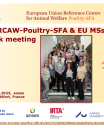
From 13-14 May, EURCAW Aqua hosted the annual meeting of the 4 EURCAWs in Heraklion. More than 40 professionals from all four EURCAWs (EURCAW Aqua, EURCAW Ruminants & Equines, EURCAW-Pigs, and EURCAW-Poultry-SFA) gathered to exchange knowledge, strengthen collaboration, and discuss future directions. A World Café to discuss topics such as how to improve the format of factsheets, quality assurance during the peer-review process, training initiatives and the community of practice was organized. The small group discussion continued, focusing on common activities across the EURCAWs such as roadshows and the development of an EURCAW App, communications, and training. Despite an earthquake in the early hours of Day 2, the meeting was a great success – facilitating fruitful discussions across the 4 EURCAWs.
The position has been filled.
We are excited to announce a PhD opportunity within the SafeFood4ClimDiet project "Characterization and ranking of microbiological risks associated with new food practices induced by climate change"
This PhD will provide the opportunity to work at the intersection of public health, climate change, and food safety.
About the PhD Project
This doctoral research will be part of a collaborative effort between ANSES (French Agency for Food, Environmental and Occupational Health & Safety) and INRAE (National Research Institute for Agriculture, Food, and Environment). The project focuses on understanding how climate change influences food production, distribution, and consumption patterns, and the resulting microbiological risks to public health.
Research Objectives:
Several research questions will be explored:
What are the microbiological hazards associated with new consumption practices in mainland France, Corsica, and overseas territories, and which foods are affected?
What tools and methodologies can be used to robustly and predictively assess these risks to rank them based on their likelihood of occurrence and severity?
What are the microbiological risks projected for 2050, and how can we adapt to them
This research will be interdisciplinary, combining risk assessment, microbiology, food science, and data science, all crucial to tackling the current environmental challenges.
Key Details of the PhD Position:
PhD supervision by Jeanne-Marie Membré (INRAE) and co-supervision by Estelle Chaix (Anses)
Location: The PhD will be based at Anses in Maisons-Alfort (94), with occasional travel to INRAE – UMR Secalim in Nantes (44).
Affiliated Doctoral School: ED VAAME (Vegetal Animal Food Sea Environment).
Start Date: September 2025.
Application Deadline: June 20, 2025.
Who Are We Looking For?
We are seeking a highly motivated candidate with a strong interest in public health, climate change, and food safety. The ideal candidate will have a Master’s degree (or equivalent) in risk assessment, food science, or agri-food engineering. The candidate should also have experience or a strong interest in data analysis, programming (R), and risk modelling.
Key skills and interests include:
Understanding the relationship between climate change and food safety.
Experience with scientific data management and analysis.
Strong organizational, planning, and communication skills.
Ability to work in an interdisciplinary team environment.
To apply and for more details, please refer to the full announcement.
The 15th annual workshop will be held at ANSES Sophia Antipolis (France) on Wednesday 15th October 2025. The EURL will welcome the representatives of the European and Third-Country NRLs. The annual workshop is the opportunity for the NRL network to exchange, to receive news from the partners and to give information on the activities run during the year.
More information to come. Stay tuned!